
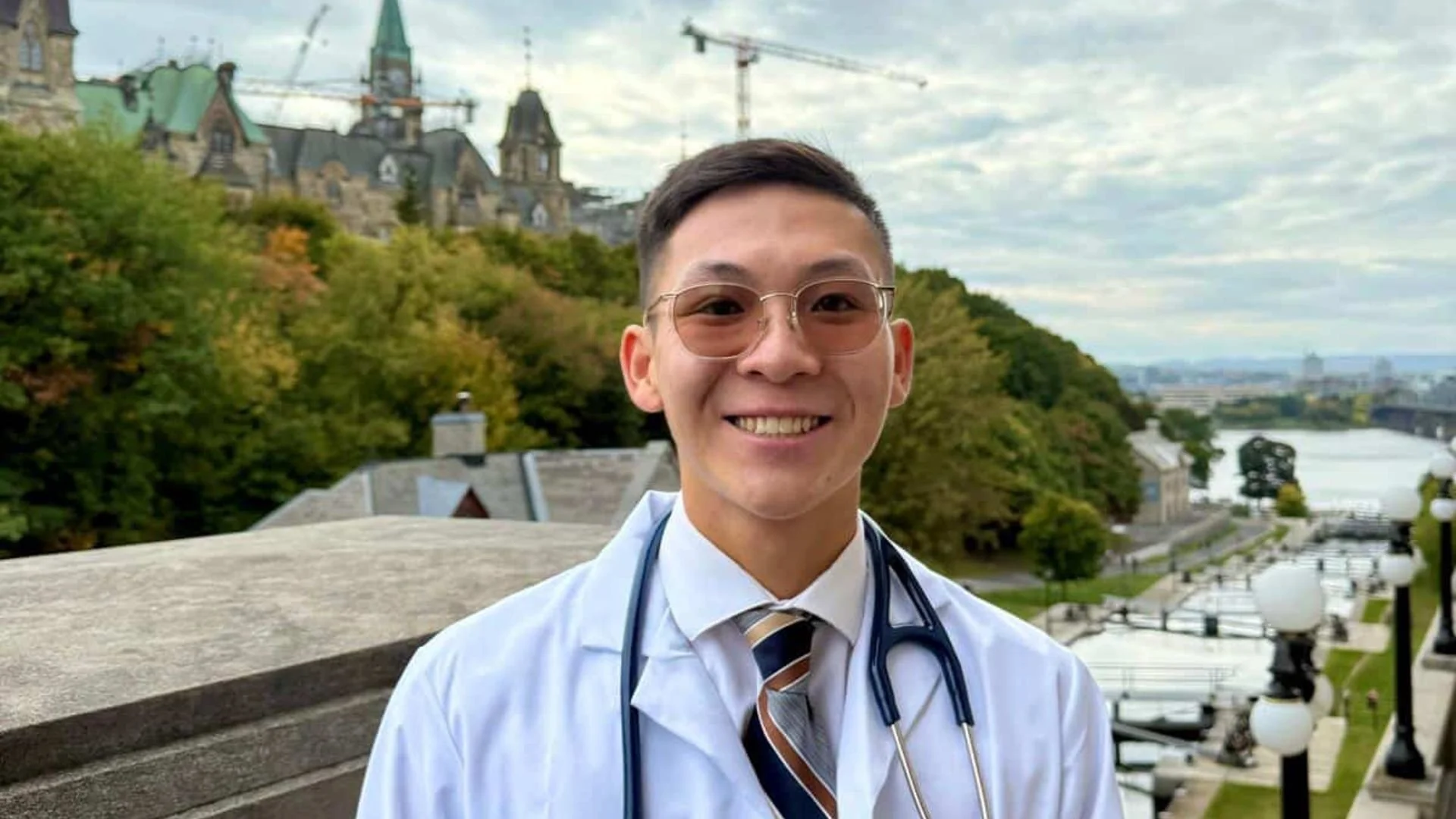
Alexander Chung gravitated towards science and medicine from an early age. His keen interest in the human body, biology, and biochemistry arose from a desire to direct his knowledge in a tangible way. “Science is a field where you can see the application in real time and in real life,” he explains. As opposed to highly theoretical fields such as mathematics, the ability to understand daily phenomena drew him to the sciences. “With biology, if you drink water, you can see what that is going to do for your body and how it sustains life. With chemistry, you can understand at a molecular level about the enzymes and the chemical reactions that are supporting your body, and do visible experiments to see that happen.”
As with Chung’s illustration of chemistry and biology, it becomes evident how science encompasses many disciplines. It is this very interconnectedness that best prepared him for medical school and opened the door to meaningful opportunities. For example, Chung’s undergraduate degree in the medical sciences not only gave him a strong foundation for the MCAT, but also allowed him to apply what he learned in didactic lectures by engaging in research. He reflects, “That [research] helps build your character and knowledge of science in the real world”.
When asked about which research experiences solidified his love for science, Chung reminisces on two distinct moments. After his second year, he worked in a dry lab studying pharmacogenetics and the way genes affect drug response. Collaborating with supportive colleagues and witnessing the real-world implications of his work fostered a profound sense of purpose. “I could see the translation between the work that I was doing and the way I was improving people’s lives,” he says. “I could find out that this mutation required a higher dose of medication, bring that to the team, and help the next sick kid respond better to a certain drug.”
Later in his fourth year, Chung pursued wet lab research for his thesis project, with a focus on skin cancer. He explains, “I really wanted to do this because I have a passion in dermatology and had never done wet lab research before.” However, it proved to be a different kind of challenge, as concrete results were hard to obtain and made it difficult to see a tangible impact. He recalls, “I had to take care of cells that weren’t very easy to manage so by the end of it, I didn’t have a very solid conclusion.” Despite these setbacks, he appreciates how these experiences strengthened his perspective on what research and scientific inquiry entails. From his perspective, a scientist has to make their hypothesis and constantly question and test those hypotheses in different ways. This sentiment captures why many of us chose to pursue a science degree in the first place; science embodies that innate, childlike curiosity and drive to question the world around us.
After completing his undergraduate degree in Honours Specialization in Physiology, Chung is now in his first year of medical school at the University of Ottawa. His path to medicine wasn’t defined by a single epiphany, but rather shaped from a culmination of experiences. As a young student, he was initially enticed by how the profession provided financial freedom to family and friends. “It was kind of an immature motivation,” he admits, “but it was a starting point to do things related to science and see if I really enjoyed that.” One pivotal moment came during his first year of undergrad while working in the hospital operation room. Witnessing a range of cases solidified his desire to become a doctor, as it required not only mechanical skill but also problem-solving and critical reasoning. By his third year, his faith further grounded his commitment to pursuing a career centered around service and compassion. Pursuing medicine became a way “to prove myself [himself] and contribute to the world as much as I could”, translating his scientific knowledge into a clinical setting. For example, after learning about hemoglobin disorders like sickle-cell disease, medical school has enabled him to apply that knowledge through case-based learning and diagnostics tests to find treatments that help real patients.
Today, Chung aspires to specialize in dermatology, a field that deeply resonates with his personal experiences. “I suffered from cystic acne and eczema,” he shares. “Speaking to my dermatologist and hearing his advice inspired me to do the same for other people.” He is drawn to dermatology to improve others’ physical health, and consequently, mental health. “The skin is the largest organ and is also the most visible one; people see your skin all the time. I want to empower younger patients like myself to feel and look better.”
When offering advice to people who want to pursue a similar pathway or are unsure of what they want to do post graduation, Chung encourages the importance of exploration. He advises, “For sciences, there will be lots of doors that will open to you along your journey. I knew I wanted to do medicine from an early age, but I have friends in many different fields such as research, industry, or pharmaceuticals. Do as many things as you can.” Chung points out that these experiences don’t have to be directly related to healthcare. Many of his experiences shaped his personal growth rather than medical school applications. Working in a soup kitchen for the past two years, for example, taught him invaluable lessons about the human connection. “When I was in that soup kitchen, we’re all just trying to get to our next meal,” he reflects. “The stories there are so rich and vibrant. It taught me what it really means to be human—to show compassion, to show love, and to interact with people.” At the same time, Chung encourages students to pursue opportunities that will contribute to your future alongside your passions. While he explored diverse roles outside of medicine, it wasn’t until he worked in a hospital that he truly understood what it meant to be a doctor or conversely, helped some of his friends realize medicine wasn’t for them. “You can only really know for yourself once you try. How can you say you want to be a doctor if you haven’t experienced it? It’s the same for other fields, how can you know you want to be a scientist if you’ve never seen what it’s like to be one?”
Western University is full of opportunities, a place to explore your interests and say yes to new experiences. “Look for those open doors, and say yes more often than you say no. I mostly regret the things I have not done, than the things that I have done.”
Note from the writer:
University is a fruitful experience when we immerse ourselves in academic and social life. Much of our identity and how we interact with others stems from being a student, and this is reflected in the way we introduce ourselves. But what happens when that chapter closes and student life no longer defines us? Upon graduation, many of us feel uncertain and pressured about post-university life. I can attest to this myself, having been asked countless times, “What are you going to do with your science degree?”
This question inspired the Spotlight Series: a space to feature alumni pursuing diverse career paths. I see these individuals as people we can aspire to be, and I hope that you find guidance, perspective, comfort, or inspiration in reading these stories.